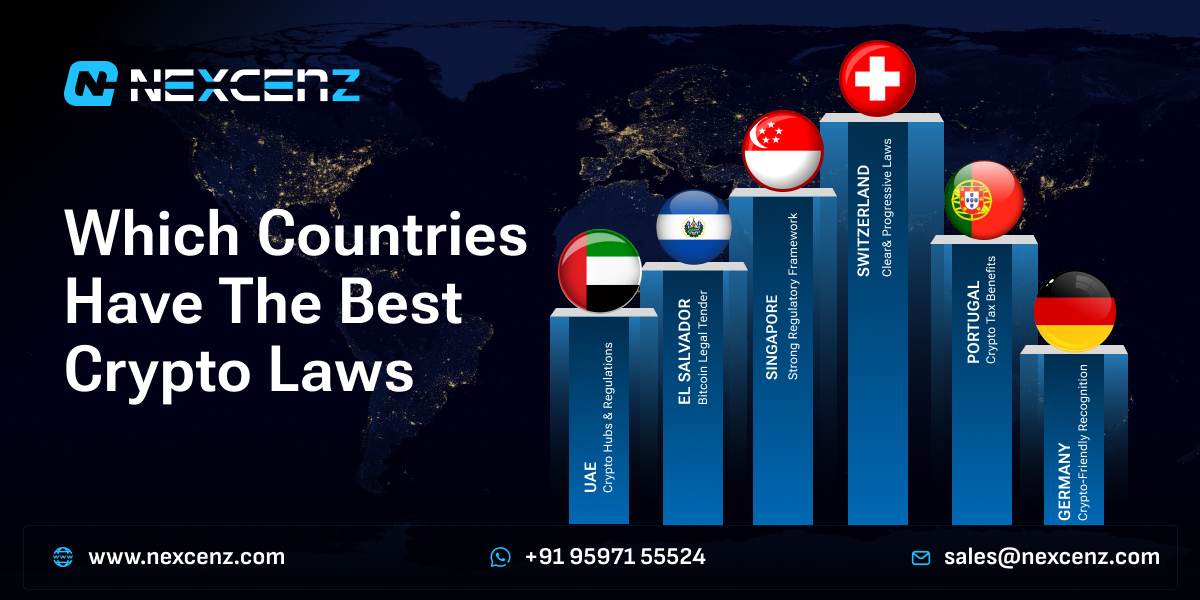
The year 2026 sees that choosing the right country to conduct business via your crypto venture, or even hold any type of digital asset at all, will determine whether you pay zero in taxes or incur hefty fines.
As the crypto markets mature, governments worldwide have reacted in different ways, ranging from a welcoming embrace to stringent regimes that impede progress.
Nexcenz works alongside Web3 startups, blockchain ventures, and digital assets holders. They constantly ask themselves one essential question: In which part of the world can I safely, efficiently, and effectively run my crypto venture?
The following guide provides the answer. Our analysis of the state of affairs across the globe has allowed us to select the best possible countries for conducting business in crypto in 2026.
1. UAE - #1 Crypto Hub in the World
The UAE leads the world when it comes to crypto regulation. The VARA of Dubai was the world's first crypto regulating authority, and in 2026, it continues to be the standard. In January 2026, the DIFC revised the Crypto Token regulations while ADGM extended its DeFi regulations in November 2025. Clearly, the UAE is evolving its strategy, not sitting on past laurels.
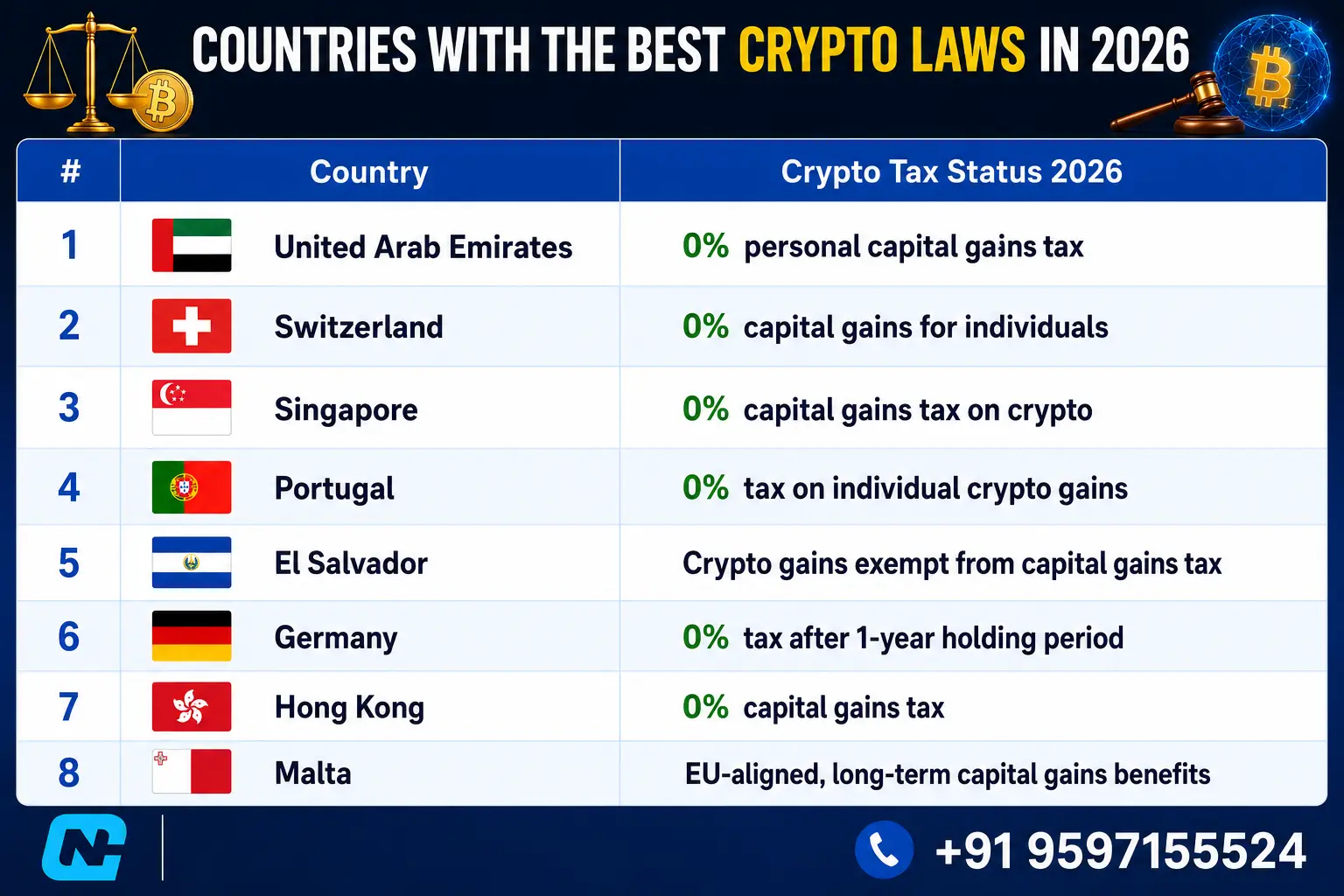
No personal income tax, no capital gains tax, more than 600 crypto firms in the DMCC free zone these factors that the UAE remains a leading crypto jurisdiction.
VARA offers an industry-leading regulatory license structure for exchanges, custody and brokering services
Triple compliance with full Travel Rule adoption
MGX of Abu Dhabi invested a whopping $2 billion into Binance in March 2025 indicating huge institutional interest in crypto
Nexcenz Verdict: The UAE stands head and shoulders above all other countries when it comes to institutionalized crypto jurisdictions in 2026. It requires full compliance with traditional financial laws but is totally worth it due to its unique advantages.
2. Switzerland - The Regulatory Gold Standard
Why Switzerland Stays Ahead
Switzerland has been friendly to cryptocurrencies since 2016. As of 2026, Switzerland is still the most legally advanced country in the world in terms of digital assets. FINMA issues personalized No-Action Letters, which means that companies receive legal assurance about their operations even before launching their products.
The Swiss Federal DLT Act grants digital assets legal parity with traditional securities. Individual investors do not have to pay any capital gains tax on crypto investments, and the Crypto Valley in Zug keeps drawing the best blockchain specialists and capital into the country.
Swiss Federal DLT Act: full legal status of tokenized assets
FINMA No-Action Letters guarantee pre-launch legal clarity - unique worldwide
No capital gains tax on individual crypto investments
BX Digital founded as the first Swiss DLT trading platform in March 2025
3. Si-ngapore - Crypto Regulation Mecca of Asia
Reasons Why Singapore Should Be Your Gateway To Asian Cryptocurrency Markets
The Monetary Authority of Singapore (MAS) is well known for its consistency despite being strict. When it comes to crypto regulation, predictability goes further than leniency. The Payment Services Act (PSA) is a good way to get a license, and the MAS simplified its Digital Payment Token licensing process in February 2026 to eliminate wait times for institutional custodians.
Without capital gains tax on crypto and with arguably the best crypto banking infrastructure in Asia, Singapore still wins the race for exchanges, crypto funds, and decentralized finance businesses targeting the Asian market.
Payment Services Act: Licensing framework for digital payments tokens
No capital gains tax for individuals or corporations on cryptocurrencies
New streamlined DPT licensing from February 2026
Solid KYC measures increase global investors' confidence
4. Portugal - Europe’s Most Tax-Efficient Crypto Haven
Why Choose Portugal for Your Cryptocurrency Investments and Nomad Lifestyle?
Portugal has distinguished itself as an excellent country for individuals who invest their cryptocurrencies due to the introduction of zero taxation on personal gains from cryptocurrencies. In 2026, individual investors do not pay any tax on their crypto gains. The personal cryptocurrency transactions in this country are exempt from VAT and capital gain taxes. Portugal continues to be one of the best countries in Europe for those looking for financial benefits.
Although European regulations concerning MiCA will be applicable to crypto businesses throughout Europe, the individual tax system in Portugal still provides many advantages.
0% tax on individual crypto gains, which is unique among the EU countries
No VAT for crypto trading
Promising Non-Habitual Resident (NHR) tax regime for newcomers in digital business
Thriving startup environment in Lisbon
5. El Salvador -Legal Environment for Bitcoin
What Makes El Salvador Special Around the World
El Salvador went down in history as the first nation to make Bitcoin a legal currency, and it stays one of the most crypto-native countries of 2026. The profits generated from the activity with cryptocurrencies are typically not subject to capital gains tax, and tax breaks apply to corporations with licensed crypto transactions.
There is a licensing scheme established by the National Commission of Digital Assets (CNAD), while there are clear rules for business with the license issued under the Bitcoin Service Provider (BSP).
Bitcoin legal tender, unique in the world in 2026
Profits from crypto activities not taxed
BSP and DASP licensing frameworks provide for regulation
The low cost of operations compared to UAE and Singapore
6. Germany - Most Reasonable Crypto Jurisdiction in Europe
Why Is Germany Unique among EU Countries?
In contrast to other countries, Germany has embedded digital assets into its established Banking Act instead of devising an entirely new framework for them, thus becoming one of the most realistic and enforceable crypto jurisdictions in Europe. The biggest advantage for investors who plan to be long term in their investments is that there is no capital gains tax on crypto if it has been held for more than a year.
Given that MiCA will apply to all crypto businesses operating in the EU since December 2024, Germany's strength is its well-developed regulatory framework and banking connections, along with the tax exemption for holding crypto.
0% capital gains tax on crypto assets held for more than 12 months
Embedded digital assets within the Banking Act — highly developed legally
Banking infrastructure for licensed crypto organizations
BaFin licenses crypto asset service providers
Conclusion: Select a Crypto Jurisdiction Strategically
When looking into what the future crypto regulatory landscape will be like in 2026, one should expect a highly evolved approach towards legislation. It goes without saying that when choosing a jurisdiction, the most important factors are those that are related to the clarity of regulation, licensing procedures, and infrastructure of each nation.
The most suitable choice for companies will be represented by the UAE and Singapore. The best options for individual investors as well as for people interested in digital nomad life and benefits will be Portugal and Germany. In turn, when speaking about businesses operating purely in terms of Bitcoin regulations, El Salvador can be considered unique.
Here at Nexcenz, our strategy experts assist clients in evaluating different jurisdictions to determine the most optimal solution in terms of their business model, risk management and Crypto Exchange Development plans. No matter whether you wish to establish a DeFi project, set up an investment fund, or simply look for the best way to minimize tax, jurisdiction selection requires careful planning and attention to detail.
Ready to select a crypto jurisdiction for your business or portfolio? We at Nexcenz will help you make this important decision strategically.


Customer feedback and reviews are our major concerns! Here we have shared a Ratings of our reputed clients







You let us know what you need, Technical experts will call to review your needs in detail.We promise to keep all information private.